Dear Honorary Loopers,
On Tuesday, September 1, we left our refuge at Port Colborne on a beam sea, which pushed the boat from side to side, but didn’t slow us down.
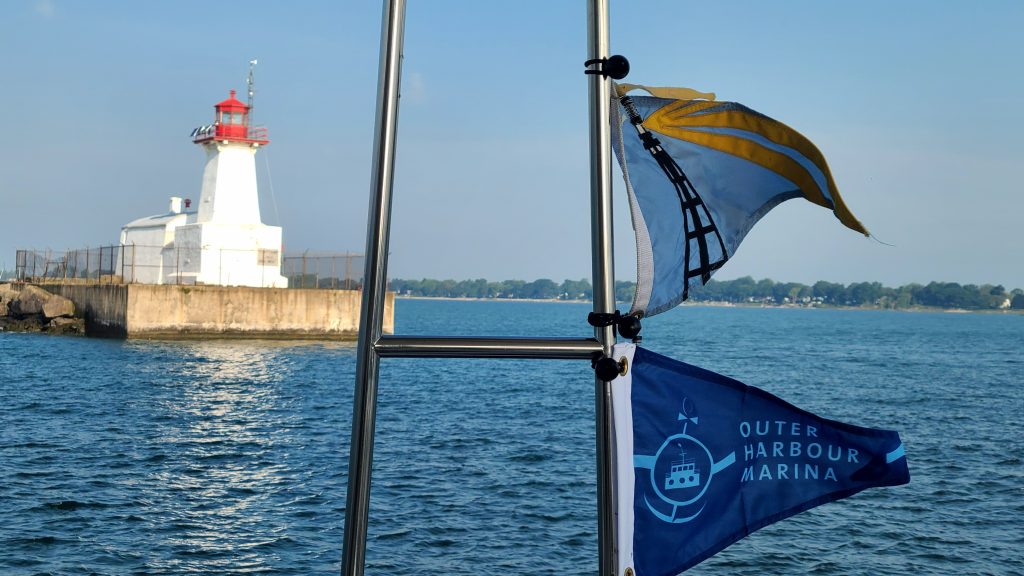
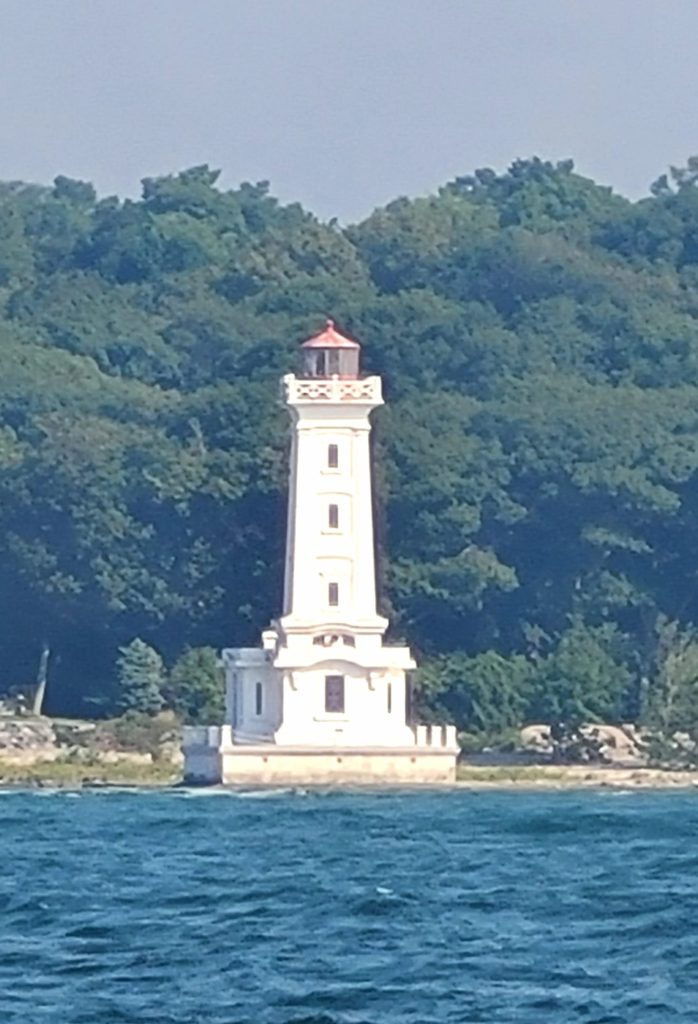
The four-hour ride tracing the north shore of Lake Erie toward the northeast “corner” was uneventful; the view included one of the many beautiful lighthouses we’ve seen on the Loop. Each one we see inspires admiration at the bravery and perseverance of the lighthouse keepers, both the men who were hired and the women who often inherited the job. Keeping the light burning required periodic trips and stairclimbing in all weather to trim the wick, replenish the oil, chop away ice from the light, and polish the Fresnel lens. Not a job to take lightly (pun intended).
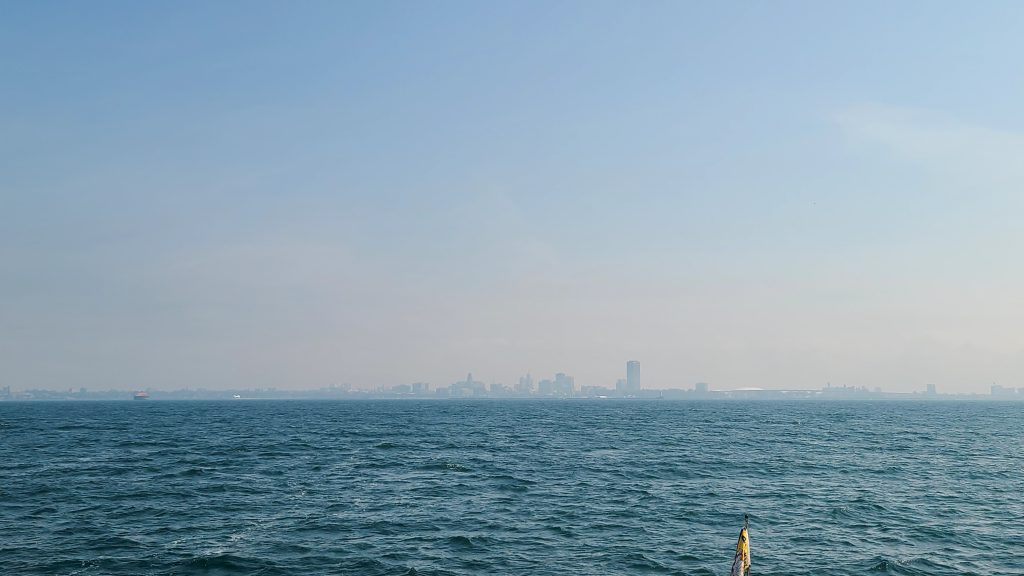
Buffalo appeared incrementally, first as a misty grey outline on the horizon; then with more definition we could discern the Niagara River, which forms the border between Canada and the US. Eventually we could see the International Peace Bridge over the river, followed by the imposing breakwater which protects the city from the lake.
Rounding the bend into Buffalo Lakeside Marina, we were directed to the fuel dock, where we checked in with US customs online, and then the young woman working the dock (a more common sight this year, I’m happy to see) directed us to the T-dock we’d share with another transient boat.
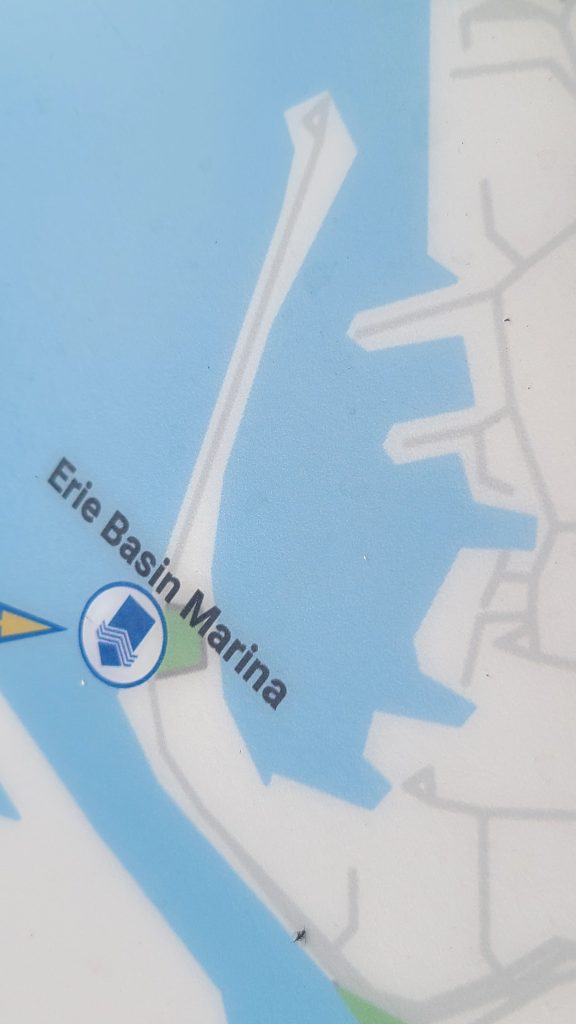
Buffalo’s Lakeside Marina was intentionally designed in the shape of – yes – a buffalo. Our boat sat near one hoof, and the essential services (restaurant, bar and ice cream shop) were situated along the spine behind the head. My morning walks took me either toward the concrete observation tower at the buffalo’s tail, or toward the head, where a trial garden (more about that later) is laid out along the western entrance to the Erie Canal (more about that later, too).
That first night, before my monthly Zoom board meeting for JAM & ALL Interfaith, Jeff and I walked to the onsite complex for an early dinner at the outdoor bar, where I had my first grilled bologna sandwich. Jeff happily stayed to enjoy the live band, in the company of the crew of the other transient boat sharing our T-dock. Brad and Greg were brothers from Florida delivering the boat to western Lake Erie. The evening exemplified the happy confluence of interesting food, live entertainment and congenial strangers that’s typical of our experiences on the Loop.
A top priority while in Buffalo was to experience “real” Buffalo chicken wings. On Wednesday, after a rainy morning of desk work, we broke out the scooters and made our way to the Anchor Bar, where in 1964 Terresa Bellissimo combined butter and her secret hot sauce to cover chicken wings, starting a lasting tradition. The Anchor Bar décor befits the center of the Buffalo wings universe, combining biker bar and kitsch. Imagine Lady Liberty holding not a torch but a platter of Buffalo wings! By the way, the wings are really delicious – thank you Mamma Teressa!
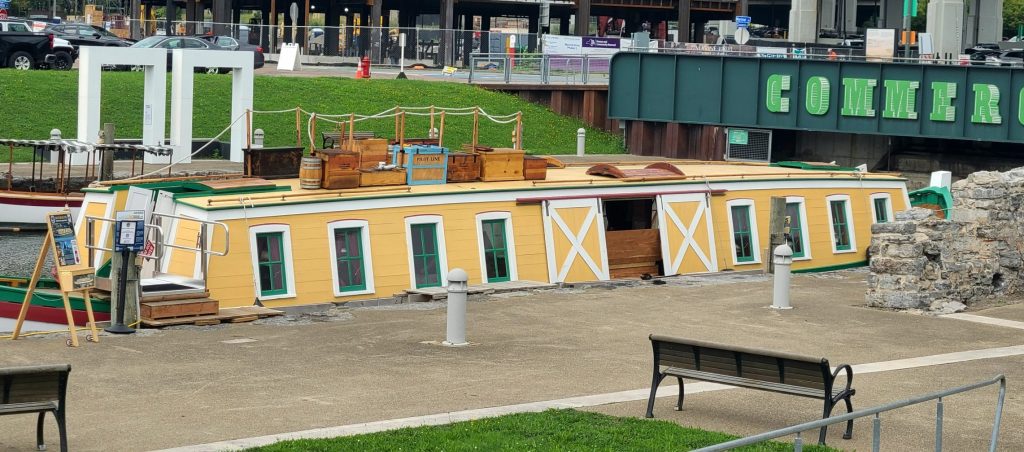
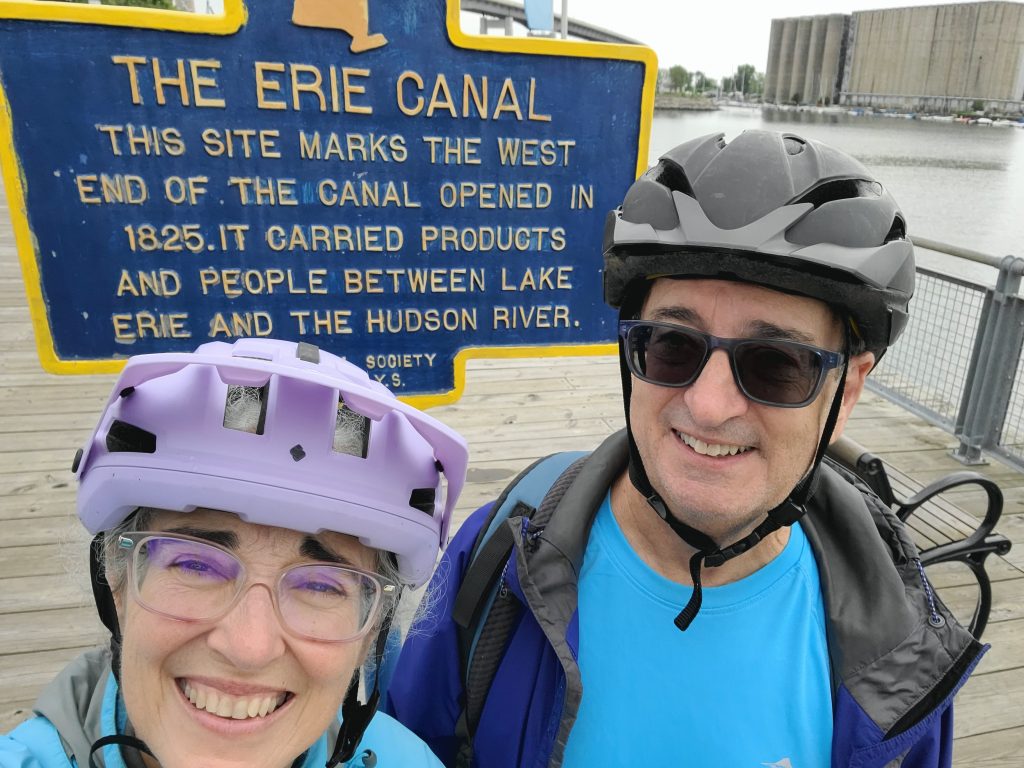
Scootering back from lunch we stopped to explore Canalside, an entertainment district along the Erie Canal. Our boat can’t fit under the low bridges of the western Erie Canal (remember the old song “low bridge, everybody down, low bridge, ‘cause we’re coming to a town?”), so this stop enabled us to “close the Loop” (pun intended) by visiting the western terminus of the Canal in Buffalo.
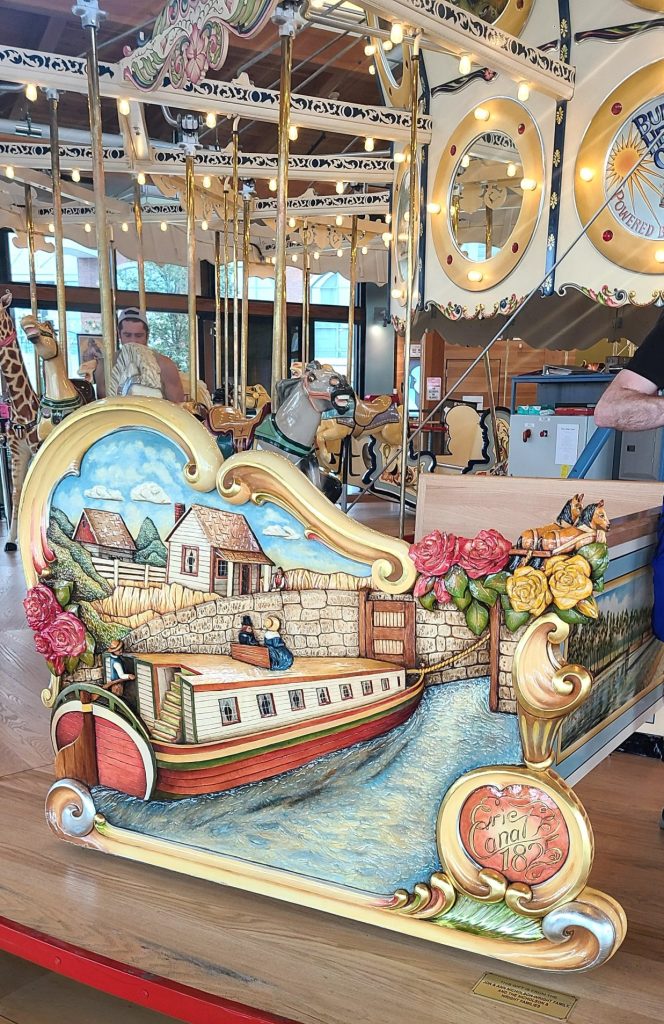
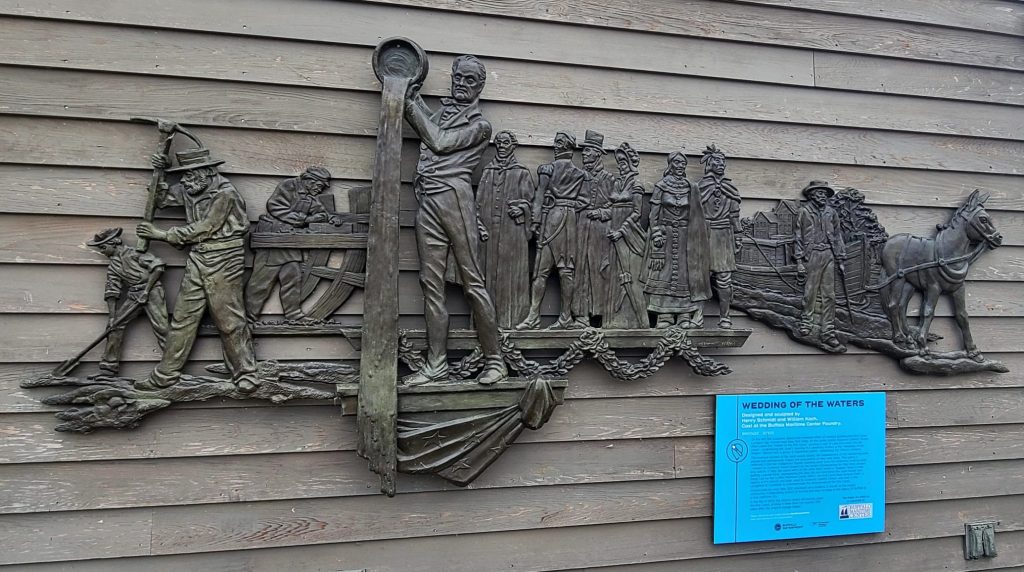
Canalside exhibits include military ships and planes, a historic carousel, abolitionist history, and a replica of the Seneca Chief, the canal boat which opened the Erie Canal in 1825. During the 2025 bicentennial Canal Celebration, the replica re-enacted that historic 363-mile voyage from Buffalo to Albany, then down the Hudson River to New York City. Once in New York Harbor, Governor De Witt Clinton emptied a keg of fresh water from Lake Erie into the salty water in a “Wedding of the Waters.” On a morning walk through the garden at the tail end of the marina, I met a woman who crewed on that re-enactment of the Seneca Chief journey. So cool to get “up close and personal” to history in that way.
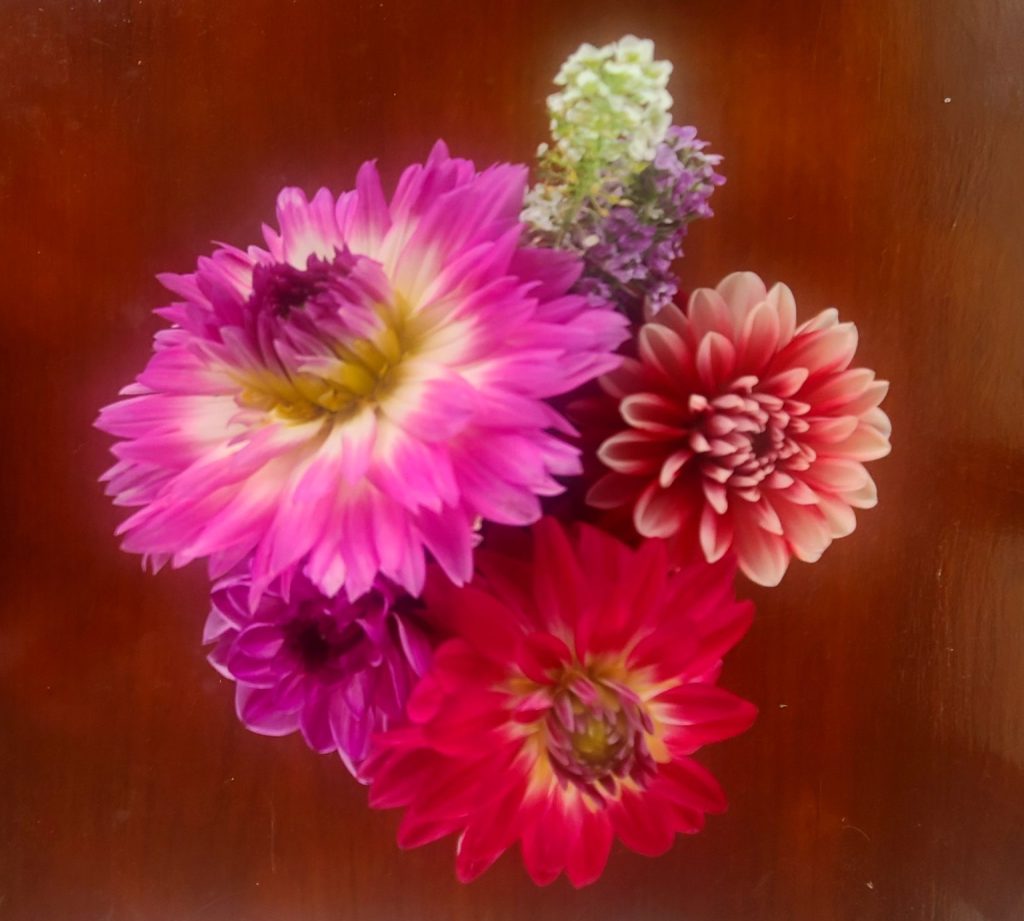
The garden had informational placards identifying the flowers, and while reading them I was hailed by the gardener. Stan plants and cares for strains of flowers to test their hardiness for the seed company, and gave me a botany lesson while clipping flowers for me, a privilege only the head gardener has.
Another Buffalo priority (Jeff indulged my passion) was to visit the Frank Lloyd Wright buildings in and around Buffalo. We rented a car to visit Graycliff, a summer home designed by Wright for the Martin family. The house stands on a lakeside bluff about an hour’s drive south of the city.
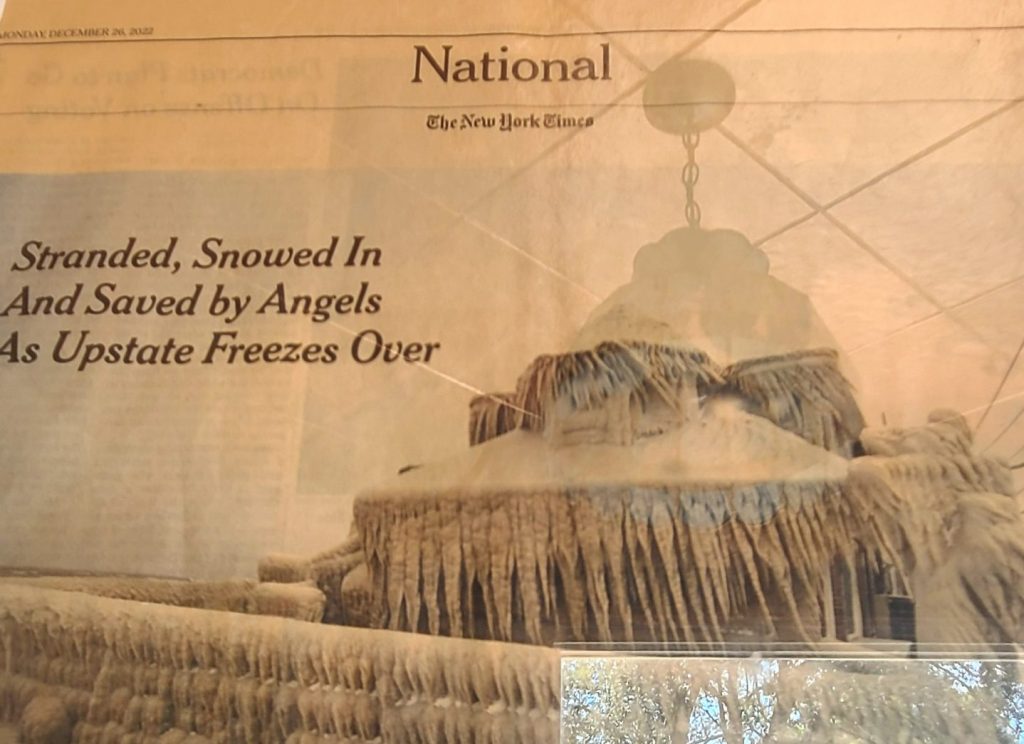
We stopped for lunch on the way at Hoak’s, a family-owned lakefront restaurant. Through the Lake Effect, winter aims its full power at Buffalo and environs; among the newspaper clippings and photos on the walls was one showing icicles covering the entire restaurant building.
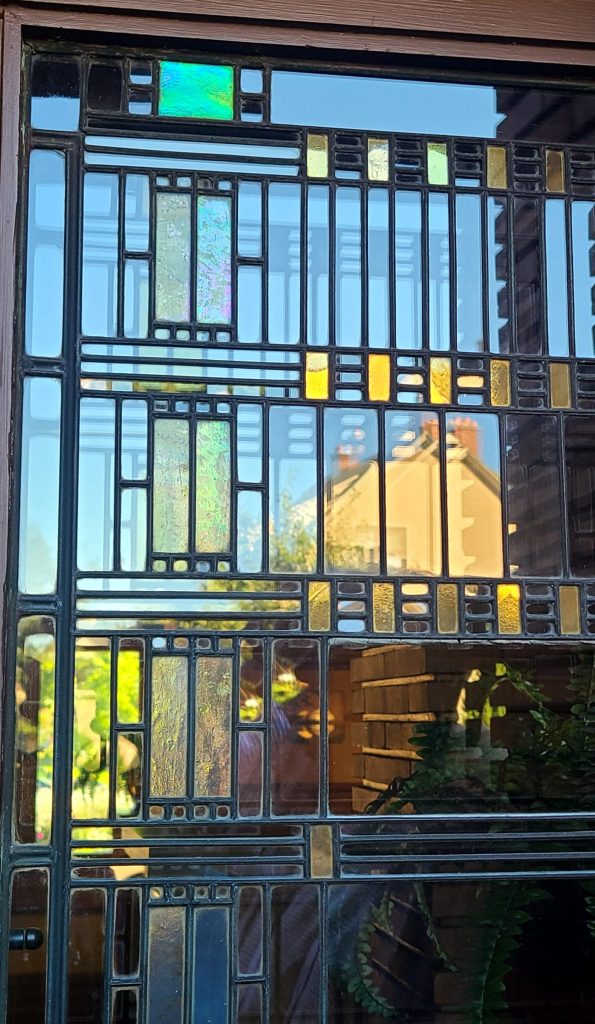
Graycliff demonstrates some of FLW’s foundational priorities. The driveway to the house cuts diagonally across the long narrow lot, and plantings hide the house from view until the last moment, when the vista opens to show the house and the lake behind it. The lake is also visible through the house, which actually consists of two structures linked by a horizontal windowed passageway. Every room has windows on at least two sides, letting natural light in and blurring the edges between inside and outside.
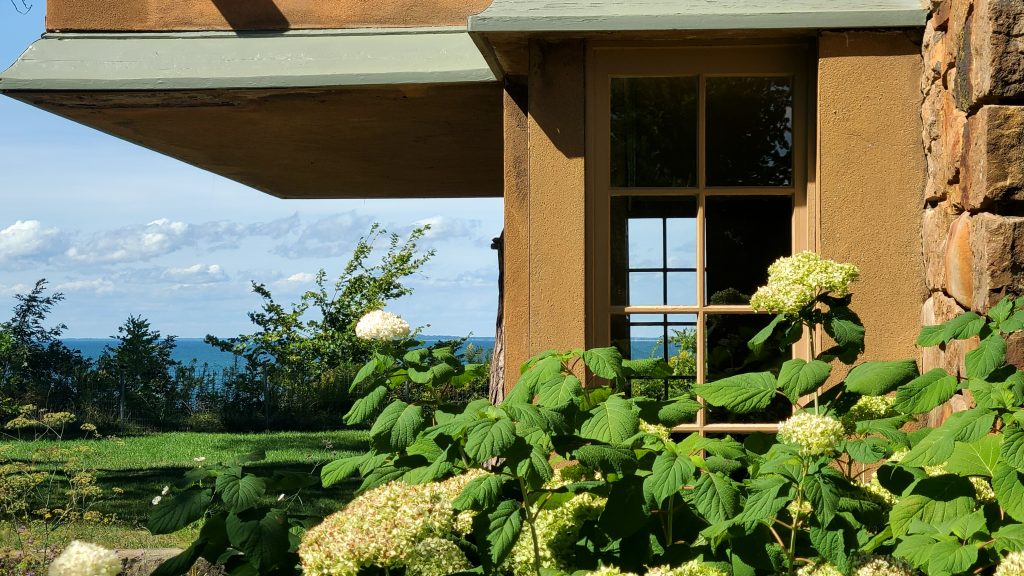
Mrs. Martin was Wright’s primary contact at Graycliff, while Mr. Martin was the decisionmaker at the Martin House in Buffalo (which Wright also designed). In the battle of wills between architect and client, at Graycliff the client mostly won. For example, Mrs. Martin requested a bathroom in the space Wright had allocated to a chimney. He protested, “I can’t put a bathroom in the chimney.” She calmly replied, “I’m sure a man of your genius won’t be stumped by a little problem like this.” She got her bathroom.
One battle that Wright won concerned the pond that he designed for the front entrance to the house. Mrs. Martin said, “I don’t need a pond,” to which Wright replied, “You may not, but your house does.” The pond IS beautiful…
We also visited three FLW buildings in Buffalo proper, including the Martin House, a boathouse, and a model of a gas station. The Martin House actually includes five FLW-designed buildings, each incorporating typical FLW design details, and we became good at recognizing them.
The main house and conservatory are connected by a “bridge,” as at Graycliff, this one an open-sided “breezeway.” The long low-roofed horizontal walkway ends in an expansive vertical space (the “reveal”) lit by natural light through the glass greenhouse roof. Within the octagonal space, lush tropical plants surround a fountain, presided over by a huge Winged Victory statue. The design inspires both awe and tranquility.
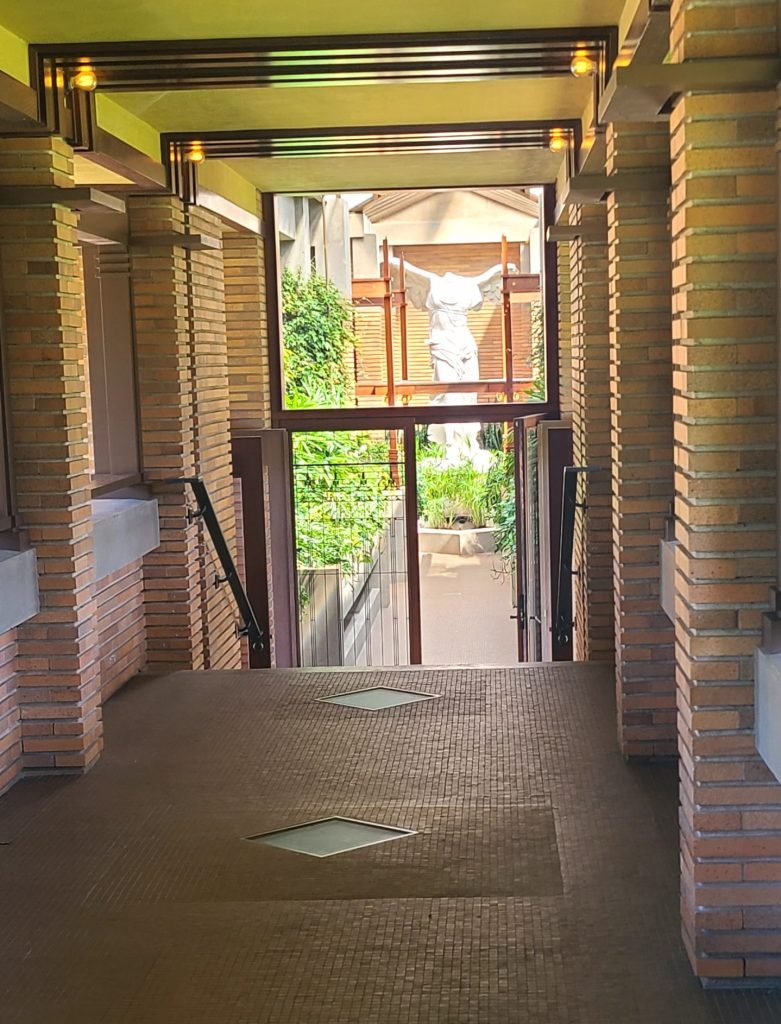
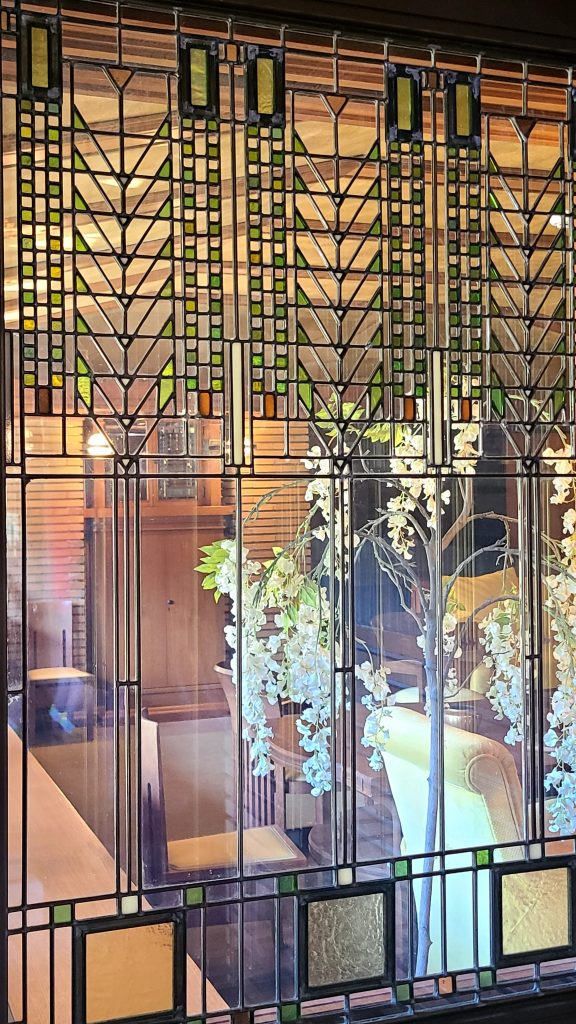
At the Martin House Mr. Martin allowed Wright to prevail on most of the decisions, resulting in some absurd designs. For instance, Mr Martin was significantly taller than FLW, but the built-in bed in the master bedroom was sized to FLW’s height. When Darwin complained that the bed was too short, Wright refused to allow it to be lengthened, claiming that it would violate the “perfect” proportions of the room. Darwin gave in (although he later had the bed lengthened without telling Wright).
One contest resulted in a compromise. Wright intensely disliked “clutter;” he didn’t design mantels on his fireplaces because people would insist on displaying things on them. However, Darwin had an extensive book collection. So Wright designed the living room with wide wood-paneled columns, and each column opened to reveal shelves of books, a win-win solution.
The FLW gas station is a life-size model of a building that was never built, and it’s probably a good thing. After all, who wants a two-story gas station with a fireplace? Genius isn’t always practical, I guess…
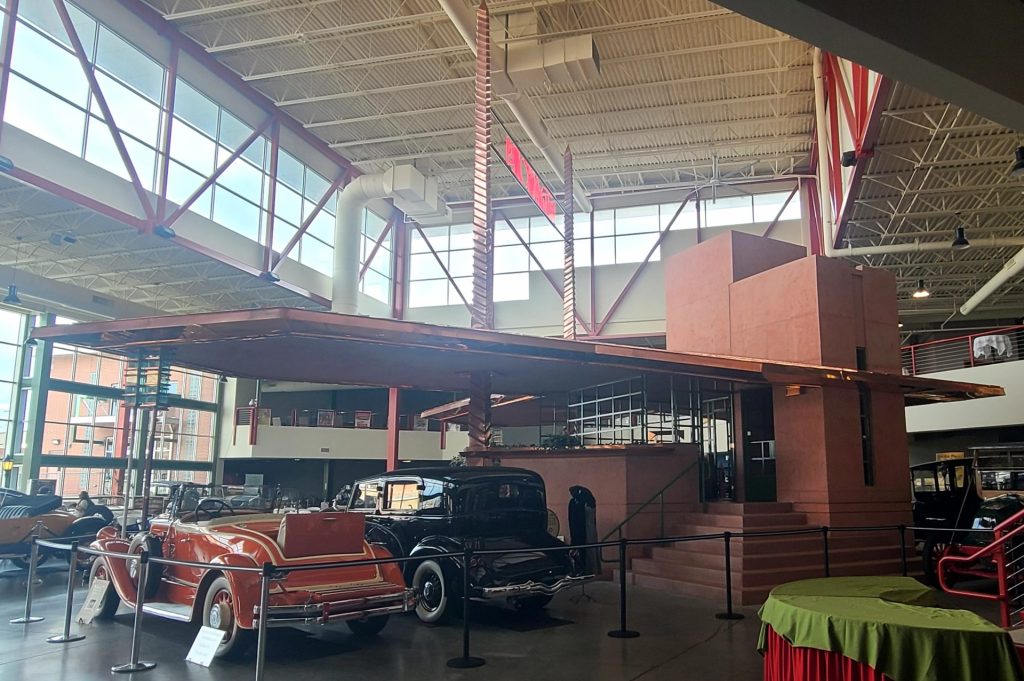
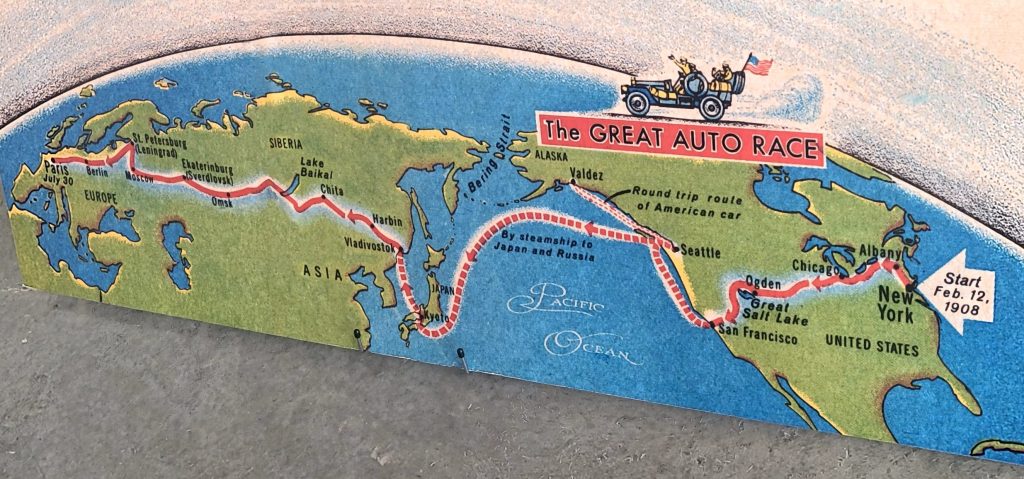
The model is located inside the Transportation Museum, which contains a fascinating array of bicycles, motorcycles, and cars, including the Pierce-Arrow cars that originally formed the nucleus of the collection. We learned about the 1908 around-the-world car rally from New York to Paris, won by a Pierce-Arrow taken right off the assembly line – not a souped-up version. It’s an incredible story of obstacles overcome, weather delays, and cultural interactions, many of which involved first contact. Imagine driving a 1908-model motor car over bridges designed for handcarts, through snow-filled gullies following sled-dogs, and along narrow lanes in villages whose inhabitants had never seen white Europeans or motor cars!
Traveling on a boat, one might assume our experiences would revolve around nautical subjects. But the Loop has exposed us to so much, not just water-related subjects. Our stay in Buffalo was a perfect example. We got so much more than we expected from this lakeside city – what a great welcome back to the United States.
Our stay in Buffalo lasted only 7 days, but ended on September 12, because we left for a long weekend in Tarrytown to attend our friend Randy’s son’s wedding. The next installment of the log will take us from September 13 to 20, and further along the southern edge of Lake Erie. Stay tuned…
Love Judy
PS A gallery of some other Buffalo experiences…