Dear Honorary Loopers,
We started the week on August 26 in Niagara on the Lake, on Lake Ontario, Canada, and by September 1 we were docking in Lake Erie, in Buffalo, NY. In between we shifted from one Great Lake to another, changed latitude, had some of the most challenging boating experiences of this trip and resolved an issue that could have been very serious. This log entry covers the first part of that week.
Leaving Niagara on the Lake on August 26, we headed west to Port Weller, and docked at a marina close to the entrance of the Welland Canal. We were still cautiously staying slow, because of our concern about the oil pressure. All seemed ok, so we settled into St. Catherine’s marina. The close-knit boating community welcomed us into their circle. We overcame our reluctance to use the wobbly narrow docks at night and joined them around a bonfire, as they swapped stories.
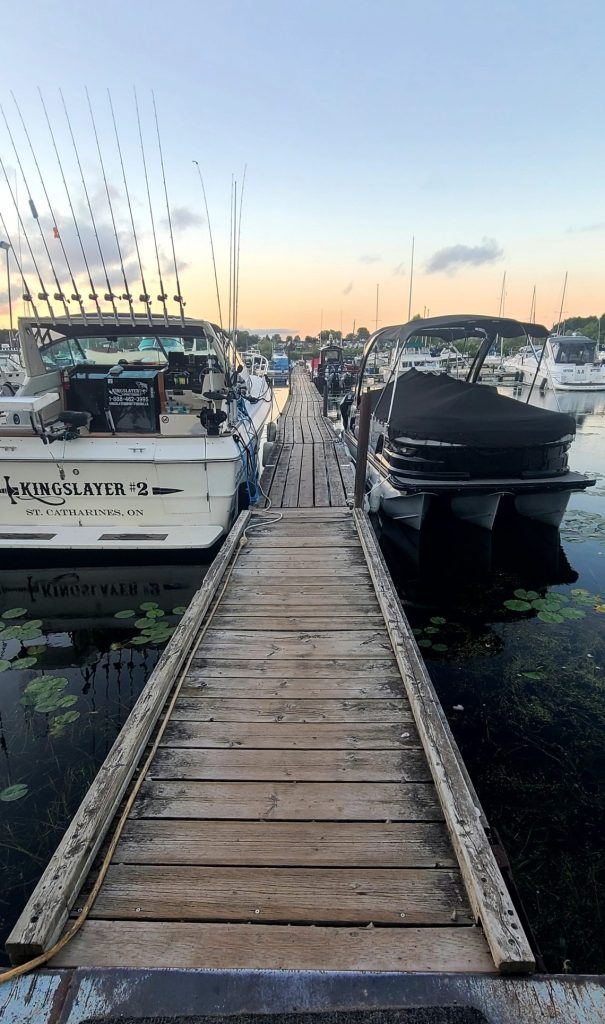
Two stories stuck with me from that evening around the fire. One very experienced boating couple explores Lake Ontario’s Thousand Islands every summer, and they’ve “gone everywhere” among the more than 1,800 islands. Everywhere, that is, but the US side! When we mentioned Clayton and Alexandria Bay NY, they revealed that they have never crossed to the US side in all their years of boating in that area. Something to remember: our particular local, or national, treasures have no monopoly on enriching lives.
The other story was told by a man who had spent years as a dive instructor in the Caribbean. He described the end of a group dive, when he was the only one left underwater alongside the wall they had been diving. He drifted up to the top of the wall and looked back over the edge. As he floated there, a whale emerged from the depths and passed him, closer to him than we were across the firepit, one large eye calmly regarding him. It then swam back down the wall, again focusing on him. As the two mammals gazed into each other’s eyes, he thought to himself, “life doesn’t get much better than this,” and for a moment considered following the whale down into the depths. His story reminded me of how often people express the wish to die in our sleep. We’re looking to minimize pain by choosing unconsciousness. He offered an alternative – what would it be like to die aware, in a moment of pure happiness?
The coast in Port Weller has wineries and farms, and we bought some fresh peaches and a peach cream pie in preparation for our daylong journey through the Welland Canal. We needed to prepare in other ways also; the Welland is different from all our prior locking experience.
The twenty-seven mile, eight-lock Canadian canal provides a commercial route between the upstream Lake Erie and the downstream Lake Ontario. It provides an alternative to the Niagara River, with its obvious obstacle to navigation (no barrels over the Falls for us, thank you!).
All commercial locks prioritize commercial vessels above PC’s (Pleasure Craft). The Welland takes this to a higher level:
- The Welland requires each PC to register in advance for a specific day, and transit is limited; at this time of year there is only one transit start time per day. PC’s can lock upbound only Mon, Wed, Fri and Sun, and downbound only Tues, Thurs and Sat. PC’s must wait for all commercial traffic, which takes priority.
- Three able-bodied crew are required to transit the Welland: one to stay at the helm throughout the transit, and two to handle the lines. Other lock systems don’t mind if the captain leaves the bridge to handle lines, and many solo Loopers transit locks along the Loop. Not in the Welland!
- Once you start the transit through the eight locks in the Welland Canal, you must proceed until the end. There are no walls above or below a lock to stay overnight, and boats are not allowed to stop. Once in, you’re committed to the whole journey.
- The journey generally takes between eight and twelve hours, due to the speed limit, the distance, and the time needed to go through each lock.
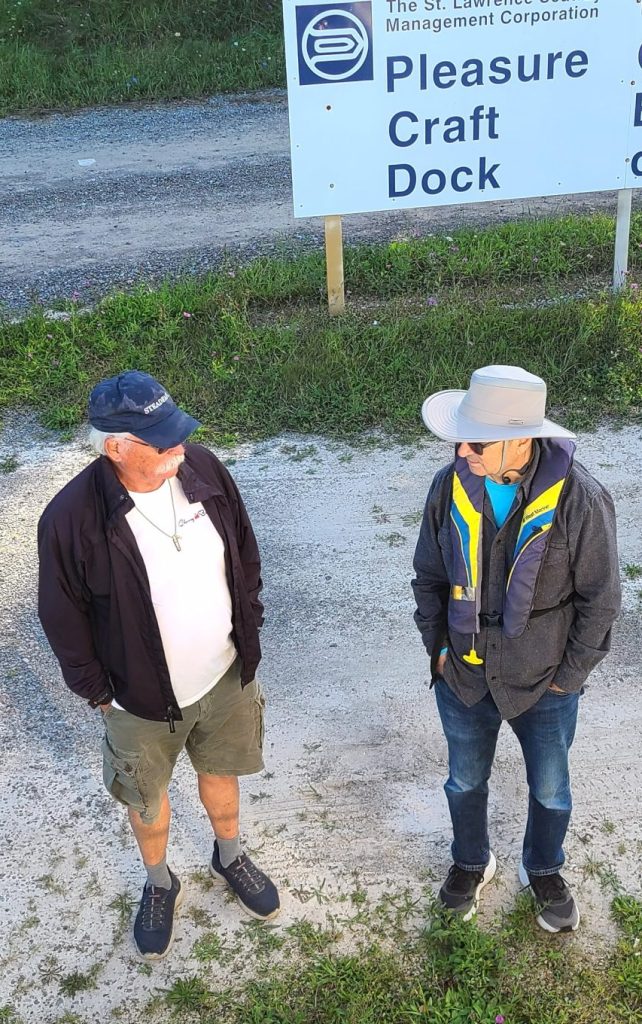
- PC’s have to call before 9:00 am to confirm that they have arrived at the Pleasure Craft Dock. If you don’t call the lockmaster in time to register, you lose your turn in line.
We signed up to transit the Welland upbound to Port Colborne on Lake Erie on Friday, August 28. But who would be our third person aboard? That would be our helpful Canadian mechanic, Bill Arthur. While he was working on our oil pressure issue in NOTL, Bill had volunteered to come with us on the Welland just for the experience. He and his dad, Bill Senior, were willing to drive over two hours just to help us and experience the Canal. We gladly accepted his offer, and Bill arranged the logistics with a friend who would meet them at Port Colborne (where Bill would leave his truck) and drive them to Port Weller to get on the boat.
The Canal Authority is very strict about being at the PC dock on time, and we endured anxious minutes as the appointed dropoff time came and went. The two Bills, starting very early, had connected with their friend with plenty of time to spare, but a bridge closure on the Canal forced them to detour to cross the Canal on the only other bridge.
When the SUV finally pulled up at the dock, the crew (and the food we had asked Bill to bring for the journey) was hauled onboard. I stowed the food (enough for a party!) and distributed life jackets as we cruised toward the Canal.
We made it to the PC Dock by 9, called in, and settled in next to the other yacht registered to transit that day. The lockmaster gave us an estimated start time of 11am. Time went by, and as we watched freighters, cruise ships, and tugboats enter and exit Lock 1, a pattern developed of recalibrating expectations: waiting, snoozing, working, eating, and waiting more. Six hours passed before we finally got the word to proceed into Lock 1 – at 3:00 pm!
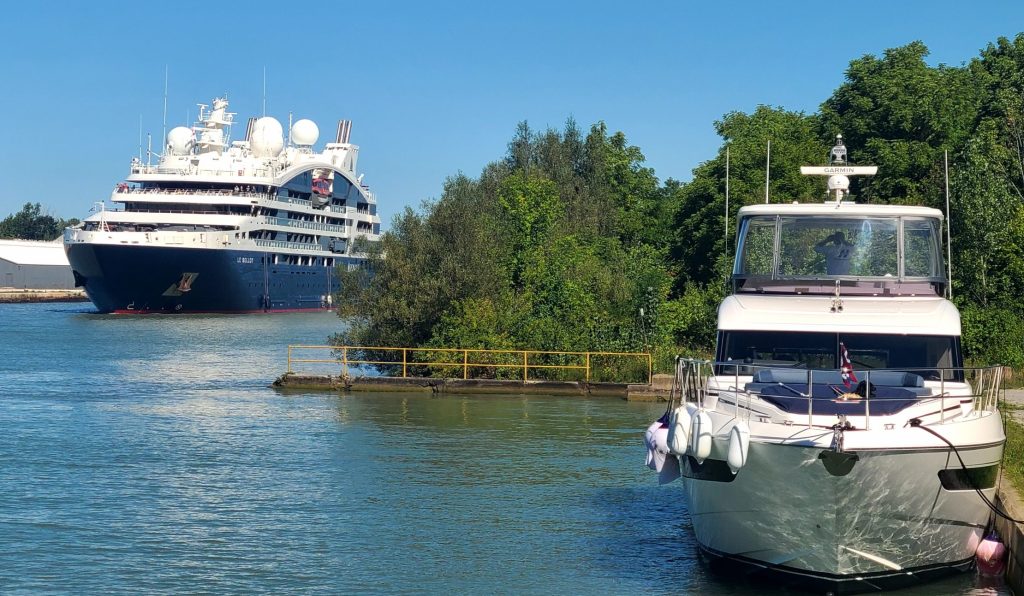
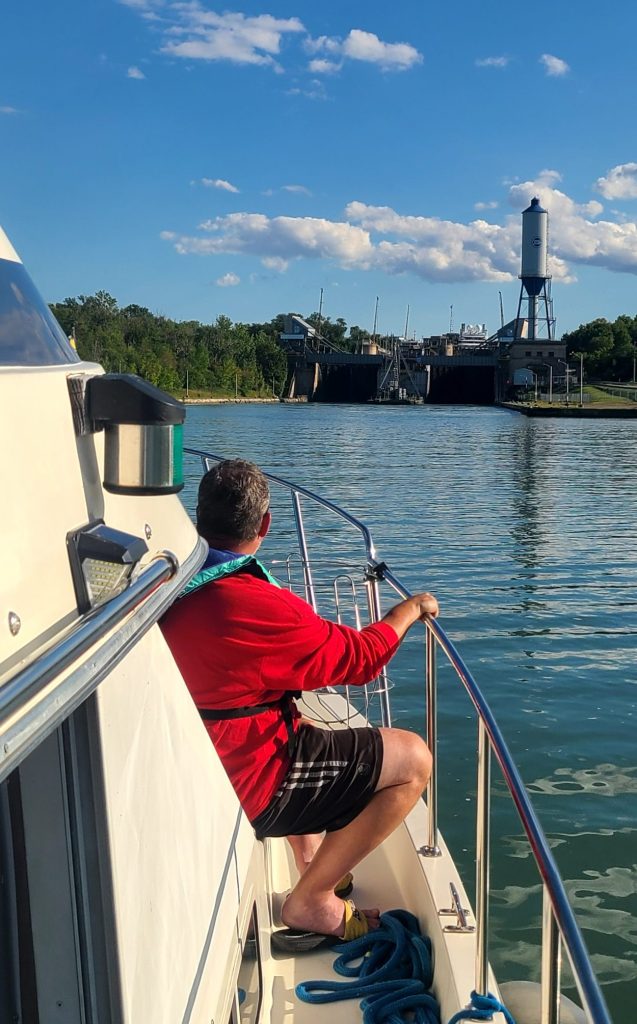
The eight locks in the Welland Canal require individual foreknowledge and preparation. The first three required a starboard tie, and we followed the other yacht in. The next three, a flight of connected locks, required port ties, and we led. At one lock, a double lock, we waited for a cruise ship to rise in one chamber while a freighter descended in the other chamber – and then waited for a train to cross the trestle, before it was our turn.
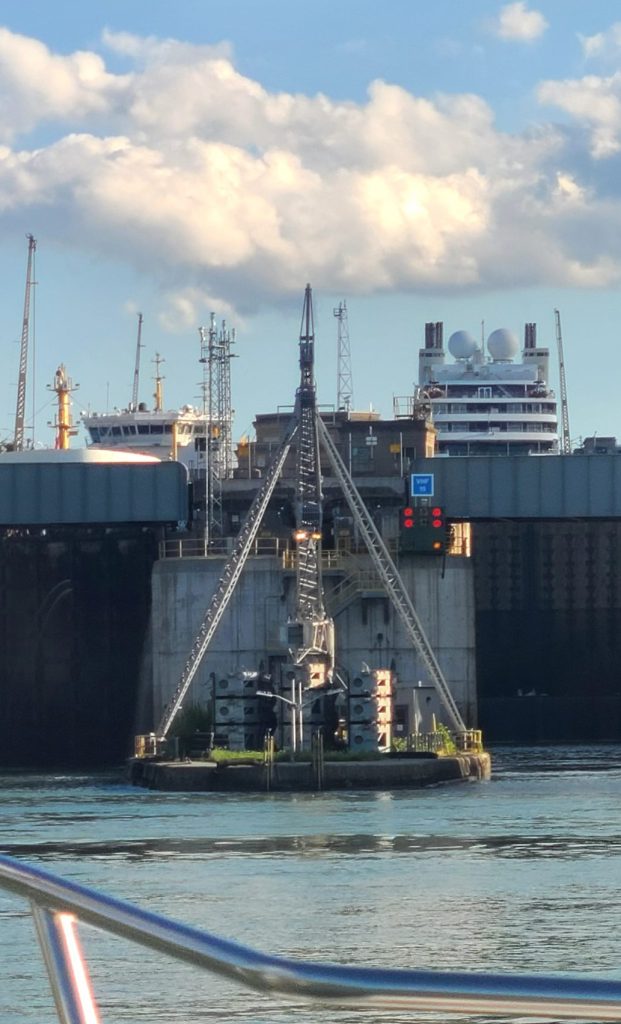
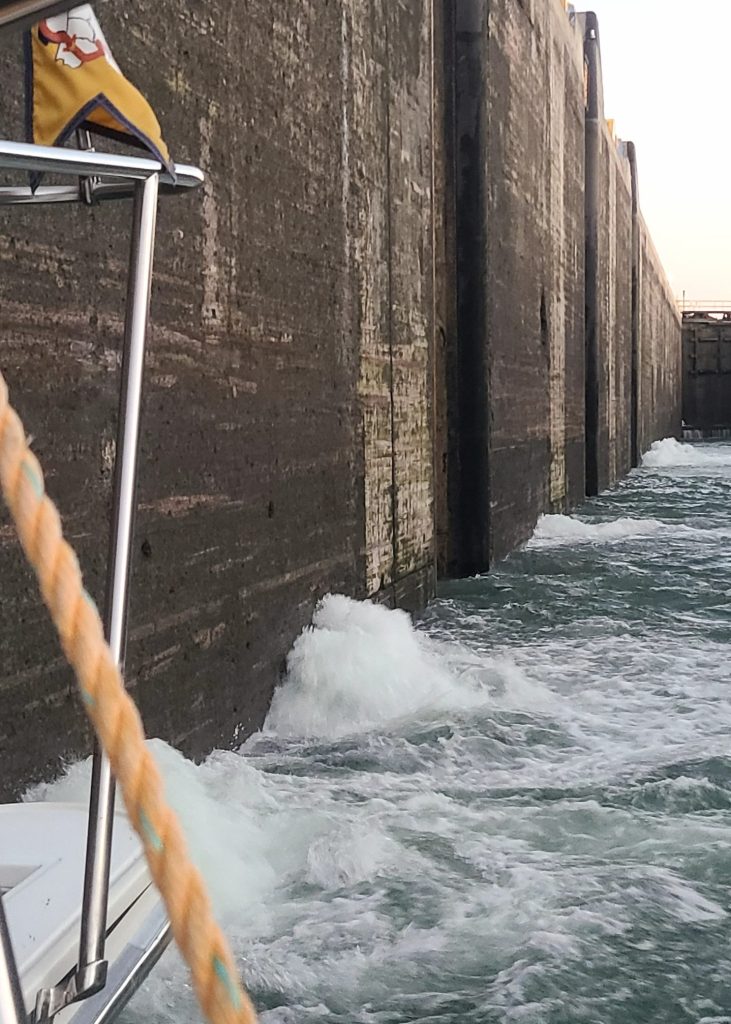
Lock 7 was the biggest challenge. Once in, I grabbed the long line thrown down from the wall above, cleating it around the bow cleat on the side of the boat away from the wall. Then I held on for dear life as water was forcefully pumped into the chamber at several places along the lock wall simultaneously. The bubbling water shoved the bow away from the wall, too hard for me to bring it back in. Bill Senior came to my rescue, gamely adding his weight and muscle. We wrestled the bow back toward the wall until the current had subsided. Good thing we had four crew!
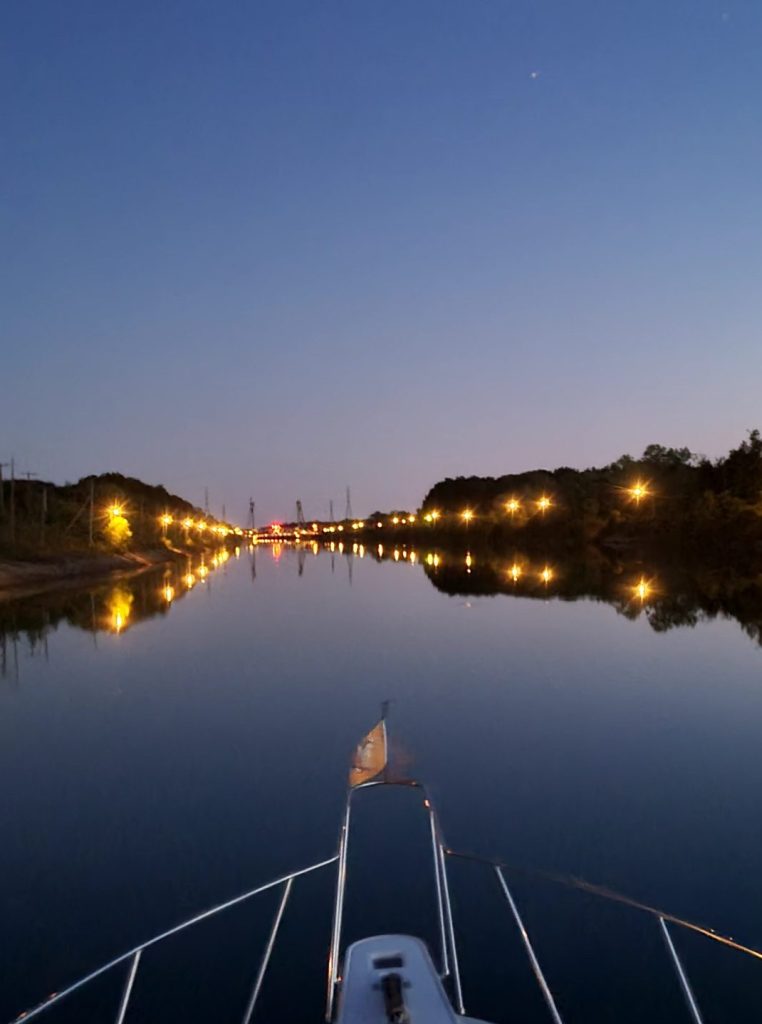
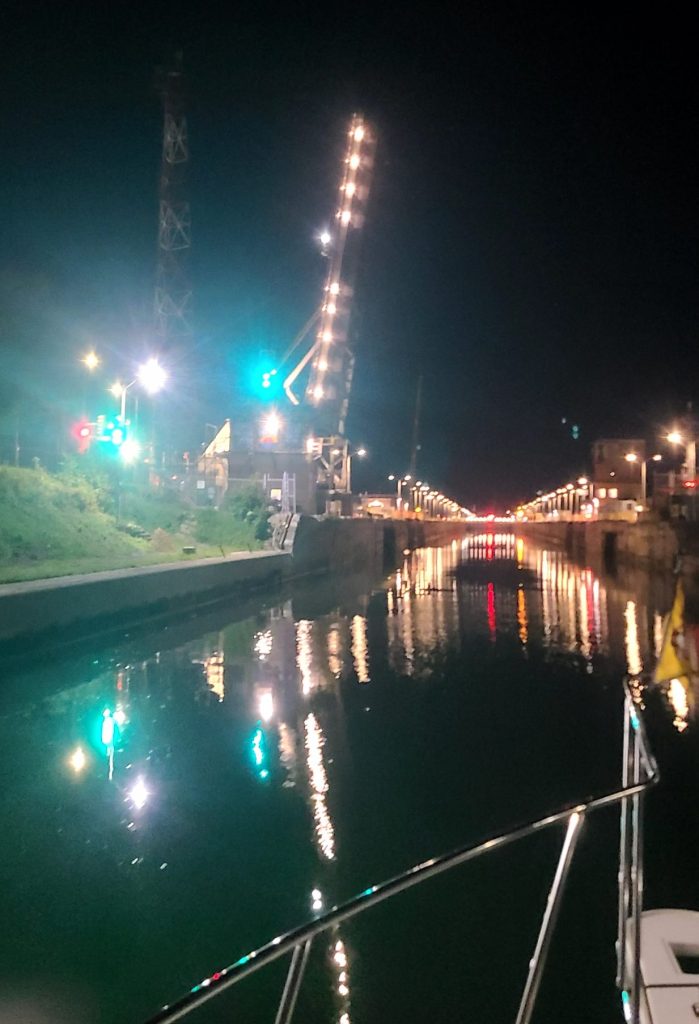
It wasn’t until 11pm that we emerged from Lock 8 and navigated into the harbor at Port Colborne. Bidding a grateful farewell to the two Bills, we watched them start their two-hour drive home and then stumbled back to the boat and crashed. Welland Canal, added to our list of Loop adventures. Whew!
We had started the day anxious – about the 9am deadline and the unknowns awaiting us, and also about the underlying oil pressure situation. Bill Junior’s calm presence was a comfort, and the boat performed flawlessly, with no gaining oil either before or after the day’s journey. So we ended the day much less anxious, and with great relief at having come through in one piece.
We also recalibrated constantly: from hurry up, to wait; from prepare, to pause; from expectation, to reality. We had no control over the timing, and only limited options for how to occupy our time while we waited. During the transit we were ordered what to do, when to do it and how to do it.
We have friends and family who are transiting their own versions of the Welland Canal. Some are dealing with life-threatening and life-limiting illnesses. Others are trying to buy a new place to live. Others are working on long-term projects without guaranteed outcomes. Delay, uncertainty, frustration, and recalibration of expectations – many deal with these daily.
Our personal Welland Canal lasted only fourteen hours. We were prepared – and lucky. And I recognize that the whole adventure was just that- an adventure, a chosen path, a voluntary journey. As absorbing and significant as it was, it’s done, and now it’s just a story we can swap the next time we’re sitting with friends around a bonfire.
The Welland was not our favorite experience, but it reminded us of some important lessons: leave room for both preparation and luck; select the best resources, both material and human, to accompany us; accept the unexpected gifts they offer; and practice recalibrating so it becomes part of the pattern and not a disruption of the pattern.
We stayed two nights in Port Colborne, partly to explore the town, but mostly to recover from doing the Welland. I’ll describe those days and our entrance back into the US next time. Meanwhile I wish you all successful transiting of your personal Welland Canals.
Coraggio!
Judy